
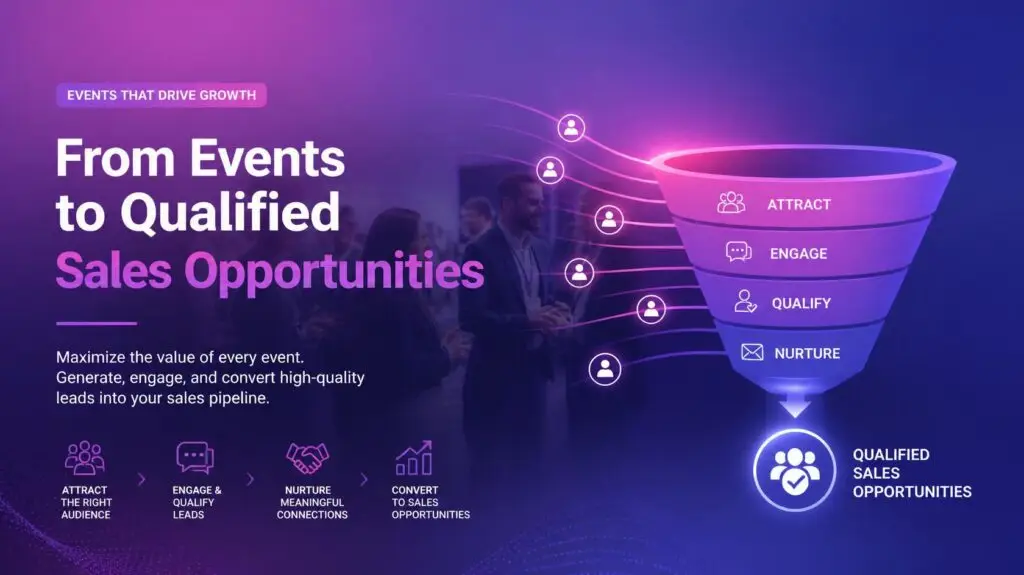
An event can put hundreds of potential buyers in the same room.
That does not mean you have hundreds of sales leads.
The difference comes from what happens before, during, and after the event.
Event lead generation is the process of identifying relevant prospects, capturing meaningful buying signals, qualifying contacts, and turning event interactions into sales conversations.
For B2B companies, that process is becoming more important in 2026. Event teams face tighter budgets and greater pressure to prove pipeline impact. At the same time, buyers expect relevant conversations rather than generic sales pitches. That creates an opportunity.
Instead of treating an event as a three-day marketing activity, businesses can treat it as a buyer-intent engine.
What Is Event Lead Generation?
Event lead generation uses conferences, trade shows, webinars, executive gatherings, networking events, product launches, and industry meetups to identify potential customers.
However, collecting a business card is not lead generation.
A useful event lead includes context.
For example:
- The company matches your ideal customer profile.
- The attendee has a relevant job function.
- The prospect discusses a business challenge your solution addresses.
- The prospect visits a product or pricing page.
- The prospect attends a product demonstration.
- The prospect requests additional information.
- The prospect engages with your team after the event.
These signals help sales teams distinguish attendance from buying intent.
That distinction matters because a database full of unqualified contacts does not create pipeline.
Why Event-Based Lead Generation Works
Events create something that many digital channels struggle to reproduce: real-time buyer interaction.
A prospect can ask a question, explain a challenge, compare solutions, or reveal a project timeline in one conversation.
That information is valuable.
Consider two contacts:
Contact A: Downloaded an industry report.
Contact B: Attended your event session, asked how your solution integrates with their existing CRM, and said their team is evaluating vendors this quarter.
Both contacts are leads.
Contact B has stronger context and a clearer reason for sales outreach.
This is where event lead generation becomes more than contact collection. It combines human interaction with measurable intent signals.
The Event Lead Generation Funnel
A strong event lead generation strategy should cover five stages.
1. Identify the Right Accounts Before the Event
Do not wait until attendees arrive.
Start with your ideal customer profile.
Identify companies that fit your target market. Then research the people attending from those organizations.
Look for:
- Job title and seniority
- Company size
- Industry
- Recent funding
- Expansion plans
- New leadership
- Hiring activity
- Technology changes
- Relevant business initiatives
These signals can help sales teams decide who deserves attention.
The objective is simple: arrive at the event with a target account list instead of starting from zero.
2. Create a Reason to Engage
Your event message should give prospects a reason to speak with your team.
Avoid vague messaging such as:
“Visit our booth to learn more about our solutions.”
That says little about the prospect's problem.
Instead, build the conversation around a specific business issue.
For example:
- Reduce sales pipeline leakage
- Improve outbound conversion
- Identify high-intent accounts
- Accelerate lead qualification
- Improve sales follow-up
- Build a more accurate prospect database
Specific problems create stronger conversations.
They also make follow-up easier because the sales team already knows what the prospect cares about.
3. Capture More Than Contact Information
A name, company, email address, and phone number are useful.
They are not enough.
Your event lead capture process should record why the person matters.
Capture information such as:
- Business challenge
- Current solution
- Buying timeline
- Decision-making role
- Areas of interest
- Event session attended
- Questions asked
- Sales conversation notes
- Follow-up preference
- Engagement level
This information turns an anonymous contact into a sales-ready profile.
It also prevents the post-event sales team from sending the same message to everyone.
4. Score Leads Using Intent Signals
Not every attendee deserves the same follow-up.
A useful event lead scoring model can combine fit + engagement + intent.
For example:
Fit
Does the company match your ICP?
Engagement
Did the person visit your booth, attend a session, participate in a demo, or speak with your team?
Intent
Did they mention an active project, budget, pain point, vendor evaluation, or purchase timeline?
You can then classify contacts into categories such as:
Hot: Strong ICP fit + high engagement + active buying signal.
Warm: Good ICP fit + meaningful engagement but unclear timeline.
Nurture: Relevant company but limited buying signals.
Disqualify: Poor fit or irrelevant use case.
This approach gives sales representatives a prioritized queue instead of another spreadsheet.
5. Follow Up While the Conversation Is Still Fresh
The event ending is not the end of event lead generation.
It is the start of the sales motion.
A delayed follow-up can turn a strong conversation into a forgotten conversation.
Instead, use the information captured during the event.
If someone discussed a specific challenge, reference that challenge.
If they attended a particular session, connect the follow-up to the session.
If they asked for a demonstration, provide the next step.
The message should answer one question:
Why should this person continue the conversation with us?
Avoid sending the same generic email to every attendee.
Event Lead Generation in the Age of AI
AI is changing how B2B teams manage events.
However, the best use of AI is not replacing the sales conversation.
It is reducing the manual work around it.
AI can help teams:
- Research target accounts
- Summarize event conversations
- Categorize attendee interests
- Identify buying signals
- Enrich prospect records
- Prioritize follow-up
- Draft account-specific messaging
- Analyze event engagement
- Connect event activity with CRM records
LinkedIn has also introduced event features focused on lead capture, promotion, measurement, and extending event value beyond the live experience.
The key is to use AI for speed and signal detection, while keeping human judgment in the sales process.
A polished automated message cannot replace a relevant conversation.
Use Intent Data to Find the Best Event Leads
One of the biggest opportunities in modern B2B event lead generation is combining event activity with external buying signals.
Imagine an attendee from a target account interacts with your team.
At the same time, that company is:
- Hiring for a relevant department
- Expanding into a new market
- Changing technology
- Launching a new product
- Increasing its sales team
- Researching a problem your solution solves
That combination creates a much stronger sales signal than event attendance alone.
The goal is not to collect more leads.
The goal is to identify accounts showing multiple signs of potential demand.
Post-Event Lead Generation: Where Most Teams Lose Pipeline
Many companies invest heavily in the event and then fall back to a basic follow-up email.
That wastes valuable context.
A stronger post-event workflow can look like this:
Day 0: Capture and categorize event interactions.
Day 1: Route high-intent leads to sales.
Day 1–2: Send personalized follow-up.
Day 3–7: Share relevant resources or schedule conversations.
Week 2: Re-engage prospects who showed interest but did not respond.
Following weeks: Move qualified prospects into account-based nurture.
The exact timeline will vary by sales cycle.
The principle remains the same: event engagement should flow directly into your sales process.
How to Measure Event Lead Generation
Event attendance is not the metric that matters most.
Track what happens after the event.
Important metrics include:
- Target accounts engaged
- Qualified leads generated
- Sales meetings booked
- Meeting-to-opportunity rate
- Opportunities influenced
- Pipeline generated
- Pipeline influenced
- Revenue generated
- Cost per qualified lead
- Cost per opportunity
- Follow-up response rate
- Lead-to-opportunity conversion
This gives marketing and sales teams a clearer picture of event ROI.
For example, an event that produces 500 contacts but only two opportunities may look successful on a registration dashboard.
An event that produces 80 highly relevant contacts and 15 sales opportunities may create significantly more commercial value.
Lead volume is not the same as lead quality.
Event Lead Generation and Account-Based Marketing
Event-based lead generation becomes even more powerful when combined with account-based marketing.
Instead of asking:
“How many leads did we collect?”
Ask:
“Which target accounts did we engage?”
That shift changes the entire strategy.
Your team can identify priority accounts before the event, engage multiple stakeholders during the event, and coordinate sales follow-up afterward.
For strategic B2B accounts, this creates a connected journey:
Target account → Event engagement → Intent signal → Sales conversation → Opportunity → Revenue
That is far more valuable than treating every badge scan as an equal lead.
Common Event Lead Generation Mistakes
Collecting contacts without context
A large contact list does not automatically create sales opportunities.
Treating every attendee as a prospect
Attendance shows interest in the event. It does not prove interest in your product.
Sending generic follow-up emails
Your prospects remember the conversation. Your follow-up should reflect it.
Ignoring low-volume, high-intent signals
One strong buying signal can be more valuable than dozens of casual interactions.
Measuring only registrations
Registrations and attendance are useful operational metrics. They should not be the final measure of commercial success.
Keeping marketing and sales data separate
If event activity never reaches the CRM or sales workflow, valuable intent signals disappear.
Build an Event Lead Generation Engine, Not a One-Time Campaign
The strongest event strategies do not end when the venue closes.
They create a repeatable system.
Before the event, identify the right accounts.
During the event, capture meaningful interactions.
After the event, prioritize prospects using fit and intent.
Then connect those signals to sales outreach and pipeline reporting.
That is the difference between event participation and event-driven revenue generation.
For B2B companies, the opportunity is not simply to meet more people.
It is to identify the right people, understand why they are interested, and give sales teams enough context to start relevant conversations.
Final Takeaway
Event lead generation works best when every interaction produces useful sales intelligence.
The winning formula is not:
More attendees → More contacts → More emails
It is:
Right accounts → Relevant conversations → Intent signals → Fast follow-up → Qualified opportunities
As event teams face greater pressure to prove business impact, this shift from attendee volume to measurable pipeline becomes increasingly important.
For businesses looking to turn conferences, trade shows, webinars, and industry events into a reliable B2B acquisition channel, the next step is clear:
Build the lead-generation process around buyer intent, not badge collection.