
Introduction
Events bring together people who are actively interested in products, services, and industry solutions. However, simply collecting attendee information does not guarantee sales opportunities. Businesses need a structured approach to identify the right prospects, capture their interest, and move them toward a sales conversation.
This is where event-based lead generation becomes valuable.
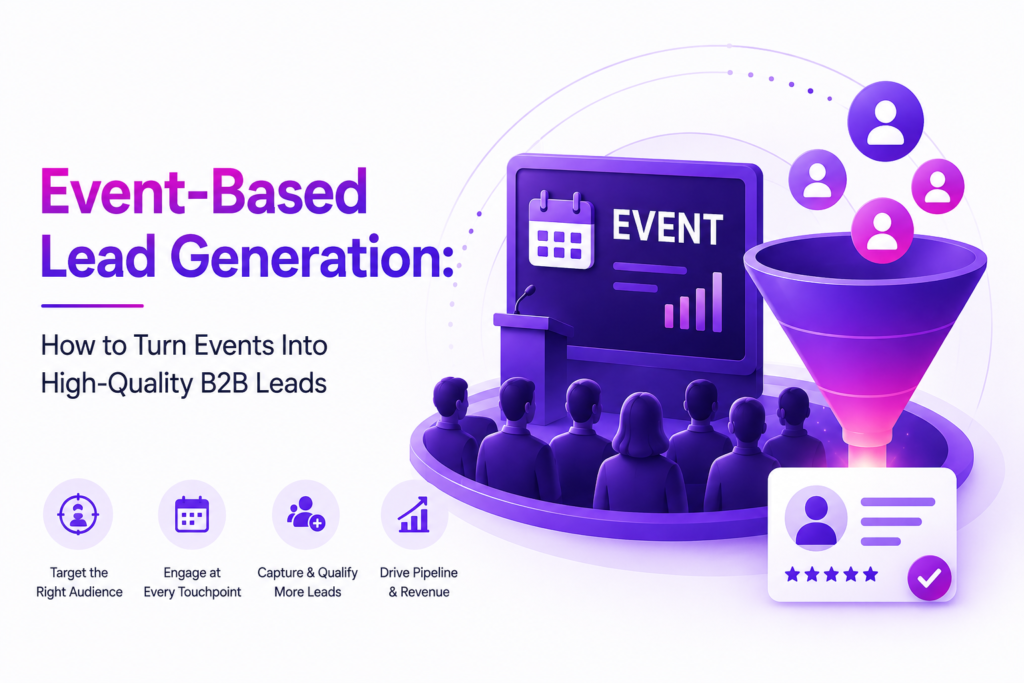
Event-based lead generation helps B2B companies turn webinars, conferences, trade shows, virtual events, and other industry gatherings into measurable pipeline opportunities. Instead of treating an event as a one-time marketing activity, businesses can use attendee data and engagement signals to build targeted lead lists and create personalized follow-up campaigns.
In this guide, we will explore how event-based lead generation works, why it matters, and how businesses can improve their event lead generation strategy.
What Is Event-Based Lead Generation
Event-based lead generation is the process of identifying, capturing, qualifying, and nurturing potential buyers through events.
These events can include:
- Webinars
- Virtual conferences
- Trade shows
- Industry conferences
- Product demonstrations
- Executive roundtables
- Networking events
- Partner events
- Workshops and seminars
The objective is not simply to increase registrations. Instead, businesses should focus on identifying high-quality prospects who show genuine interest and have the potential to become customers.
For example, someone who registers for a webinar and spends most of the session engaging with the content may be more valuable than someone who registers but never attends.
Why Event-Based Lead Generation Matters for B2B Companies
B2B buying journeys are often longer and involve multiple decision-makers. As a result, marketers need more than basic contact information to understand prospect interest.
Events provide an opportunity to collect meaningful engagement data.
For example, marketers can evaluate:
- Event registrations
- Attendance
- Session participation
- Content downloads
- Questions asked
- Poll responses
- Product interest
- Booth interactions
- Follow-up responses
These signals can help marketing and sales teams prioritize prospects based on their level of engagement.
Better Lead Quality
Events often attract people who already have an interest in a particular topic or solution. Therefore, event-generated leads can have stronger intent than contacts acquired through broad audience campaigns.
More Relevant Conversations
Event engagement gives sales teams additional context. Instead of starting with a generic sales message, representatives can reference the prospect's interests and event activity.
Stronger Marketing and Sales Alignment
A well-designed event lead generation process defines what happens after registration, attendance, and engagement. This helps marketing and sales teams agree on which leads require immediate follow-up.
How Does Event-Based Lead Generation Work?
A successful strategy typically follows several stages.
1. Define Your Target Audience
Before promoting an event, identify the companies and decision-makers you want to attract.
This may include:
- Industry
- Company size
- Geography
- Revenue
- Job function
- Seniority
- Technology usage
- Business challenges
A clearly defined audience helps improve both registration quality and downstream conversion.
2. Promote the Event to the Right Audience
Event promotion should focus on reaching relevant prospects rather than maximizing registrations at any cost.
Businesses can use channels such as:
- Email marketing
- LinkedIn campaigns
- Content syndication
- Account-based marketing
- Partner promotions
- Paid advertising
- Organic social media
For example, an enterprise cybersecurity webinar should target security leaders and relevant IT decision-makers rather than a broad technology audience.
3. Capture Useful Lead Information
Registration forms should collect enough information to support qualification without creating unnecessary friction.
Useful fields can include:
- Full name
- Business email
- Company
- Job title
- Industry
- Company size
- Business challenge
- Purchase timeframe
The exact fields should depend on the event and campaign objective.
4. Track Engagement
Registration alone does not tell you whether someone is genuinely interested.
Track engagement throughout the event lifecycle.
For example:
Registered → Attended → Engaged → Requested Information → Sales Follow-Up
This creates a clearer picture of buyer intent.
A prospect who attends an event, participates in a poll, downloads additional content, and requests a product discussion may deserve higher priority than someone who only registered.
How to Qualify Event Leads
Not every event attendee is sales-ready. Therefore, lead qualification is an essential part of event-based lead generation.
A simple qualification model can evaluate four areas:
Intent
Is the prospect actively researching a solution?
Authority
Does the person influence or make purchasing decisions?
Fit
Does the company match your ideal customer profile?
Timeline
Is there a defined project or potential purchase timeframe?
Combining these factors helps businesses distinguish between general interest and genuine buying intent.
Using Lead Scoring for Event Campaigns
Lead scoring can make event follow-up more efficient.
For example, a business could assign points based on actions:
| Lead Activity | Example Score |
|---|---|
| Registers for event | +5 |
| Attends event | +10 |
| Participates in poll | +5 |
| Downloads related content | +10 |
| Requests product information | +20 |
| Books a meeting | +30 |
These values are examples and should be customized according to your sales cycle and campaign objectives.
The goal is to create a consistent framework for prioritizing leads.
Personalize Follow-Up After the Event
The period immediately after an event is important. However, sending the same message to every attendee can reduce engagement.
Instead, segment prospects according to their behavior.
For example:
Attended but showed low engagement:
Send educational content related to the event.
Highly engaged attendee:
Send a relevant case study or solution-focused resource.
Requested product information:
Route the lead to sales for timely follow-up.
Missed the event:
Offer the recording or relevant content and continue nurturing.
This approach makes follow-up more relevant and helps sales teams focus on the most promising prospects.
Event-Based Lead Generation for Webinars
Webinars are particularly useful for B2B demand generation because they allow marketers to measure engagement digitally.
Businesses can track:
- Registration
- Attendance
- Watch time
- Questions
- Poll participation
- Resource downloads
- CTA clicks
- Meeting requests
These insights can help identify prospects who demonstrate stronger interest in a specific solution.
For instance, a prospect who watches most of a webinar about cloud security and later downloads a cloud security checklist could be prioritized for additional nurturing.
Event-Based Lead Generation for Trade Shows and Conferences
Physical events create additional opportunities to capture buyer intent.
Businesses can collect information through:
- Booth conversations
- Badge scans
- Demo requests
- QR-code forms
- Meeting bookings
- Product demonstrations
- Business card exchanges
However, collecting a contact is only the beginning.
The next step should be to categorize leads based on engagement and potential fit. This makes post-event follow-up more organized and measurable.
Common Event Lead Generation Mistakes
Many businesses invest heavily in events but lose opportunities because of weak follow-up processes.
Focusing Only on Registrations
A large registration number does not necessarily indicate strong lead quality.
Treating Every Lead Equally
An engaged decision-maker and a casual attendee should not receive the same sales follow-up.
Waiting Too Long to Follow Up
Prospects may lose interest when follow-up is delayed. Sales and marketing teams should establish a clear post-event process.
Ignoring Engagement Data
Registration data alone provides limited insight. Engagement behavior can provide stronger signals about interest.
Sending Generic Follow-Up Messages
Personalized communication based on event behavior is often more relevant than a one-size-fits-all email.
How X-Engage Can Support Event-Based Lead Generation
For B2B marketers, understanding what prospects do after they interact with event-related content can provide valuable context.
X-Engage by SalesGarners helps businesses capture and analyze engagement signals across digital content and interactions. Marketers can use engagement insights to better understand prospect behavior and identify opportunities for timely follow-up.
By combining event activity with broader content engagement, businesses can create a more complete view of buyer interest.
This can help teams move from simply collecting leads to identifying prospects who demonstrate meaningful engagement.
Key Metrics to Measure Event Lead Generation
To understand whether your event campaign is working, track metrics across the complete funnel.
Important KPIs include:
Registration Rate:
How many target prospects register?
Attendance Rate:
How many registered prospects actually attend?
Engagement Rate:
How actively do attendees participate?
Marketing Qualified Leads (MQLs):
How many leads meet your qualification criteria?
Sales Qualified Leads (SQLs):
How many leads are ready for sales engagement?
Meeting Conversion Rate:
How many event leads schedule conversations?
Pipeline Generated:
How much potential revenue can be attributed to the campaign?
Lead-to-Customer Conversion:
How many event-generated leads eventually become customers?
Looking beyond registrations helps businesses understand the actual business impact of their event strategy.
Build a Complete Event-Based Lead Generation Strategy
A successful strategy connects every stage of the buyer journey.
Target → Promote → Capture → Engage → Qualify → Nurture → Convert
First, identify your ideal audience. Next, attract relevant prospects to the event. Then capture useful information and monitor engagement.
After that, score and segment leads based on their behavior. Finally, provide personalized nurturing and sales follow-up.
This creates a repeatable process instead of treating every event as a standalone campaign.
Conclusion
Event-based lead generation can help B2B companies turn events into a consistent source of qualified opportunities. The key is to look beyond registrations and focus on engagement, intent, qualification, and timely follow-up.
Webinars, conferences, trade shows, and virtual events can all generate valuable prospects when supported by the right data and follow-up strategy.
For businesses looking to improve lead quality, combining event data with broader buyer engagement signals can create a stronger foundation for demand generation and sales growth.
Ready to turn event engagement into qualified B2B opportunities? Explore SalesGarners and discover how data-driven lead generation can support your pipeline.