
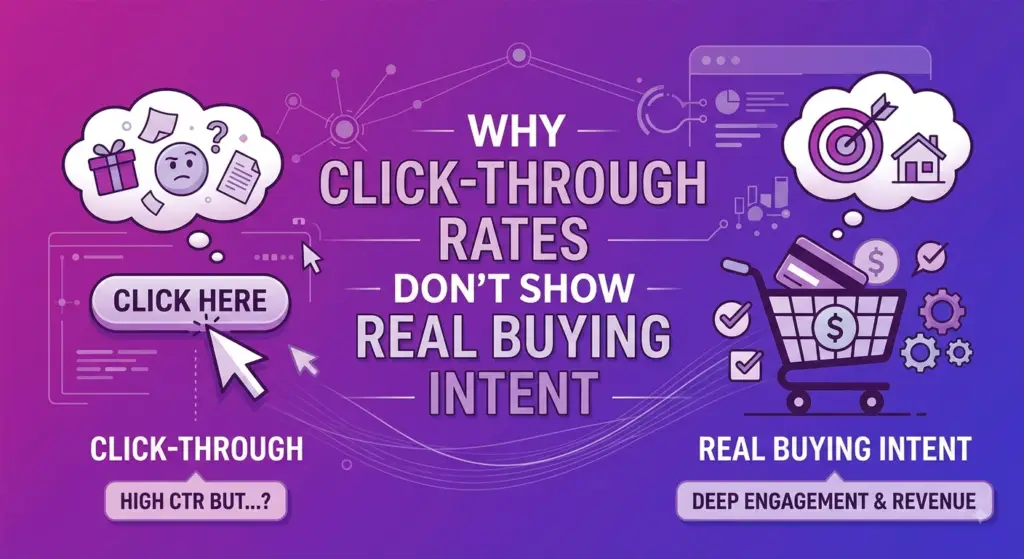
A high click-through rate looks good in a B2B marketing report. More people clicked the email, opened the landing page, or downloaded the content. But a click alone does not tell you whether those people are actually considering a purchase.
That is where many B2B campaigns go wrong.
A Click Shows Interest, Not Intent
Someone can click a B2B ad because the headline caught their attention. They might be researching a topic, comparing solutions, looking for information for a colleague, or simply curious about the offer.
For example, an IT manager may click an article about data security because they are researching industry trends. That does not necessarily mean they are looking for a security vendor.
This is why click-through rate (CTR) should not be treated as a direct measure of buying intent.
Why High CTR Can Be Misleading
A campaign can generate thousands of clicks while producing very few sales opportunities.
Common reasons include:
- The content appeals to a broad audience.
- The headline creates curiosity without purchase intent.
- People are researching rather than buying.
- The offer attracts students, job seekers, competitors, or existing customers.
- The campaign reaches the right job title but the wrong company or account.
CTR measures a reaction to a piece of content. It does not measure where that person is in the buying process.
What Real B2B Buying Intent Looks Like
Real buying intent is usually visible through a combination of signals.
For example, an account repeatedly researching a specific solution, visiting relevant product pages, engaging with comparison content, and showing activity from several people within the same company provides a much stronger indication than one person clicking an advertisement.
This is where B2B intent data becomes useful.
Intent data can help marketing and sales teams identify accounts that are actively researching topics connected to their products or services. When combined with firmographic data, engagement information, and account activity, marketers can build a clearer picture of which companies may be moving toward a buying decision.
CTR vs. Intent Data
Think of CTR as answering:
“Did someone respond to this content?”
Intent data helps answer:
“Is this account showing signs that the topic matters to its current business needs?”
Those are two very different questions.
A campaign should therefore be evaluated using more than clicks. Look at qualified accounts, engagement depth, repeat activity, content consumption, decision-maker involvement, and ultimately the opportunities generated.
The Better Way to Measure B2B Campaigns
Instead of chasing the highest CTR, B2B marketers should connect campaign engagement with account-level signals.
A strong measurement framework can include:
CTR → Account engagement → Intent signals → Qualified lead → Sales opportunity → Pipeline
This gives sales and marketing teams a clearer view of whether campaigns are attracting potential buyers rather than simply attracting traffic.
Final Takeaway
A high CTR can tell you that your message attracted attention. It cannot tell you that the person is ready to buy.
For B2B marketers, the real opportunity is to look beyond individual clicks and understand which accounts are researching, engaging, and showing consistent interest in a solution.
When CTR is combined with intent data, account intelligence, and qualified engagement signals, marketing teams can spend less time chasing clicks and more time identifying accounts that are worth a sales conversation.