
A software company launches a campaign targeting IT leaders in manufacturing. The audience matches its ideal customer profile, but engagement remains low.
At the same time, another group of companies is actively researching solutions, consuming industry content, and comparing vendors but those accounts aren’t even on the marketing team’s target list.
This is where B2B intent data can make a difference.
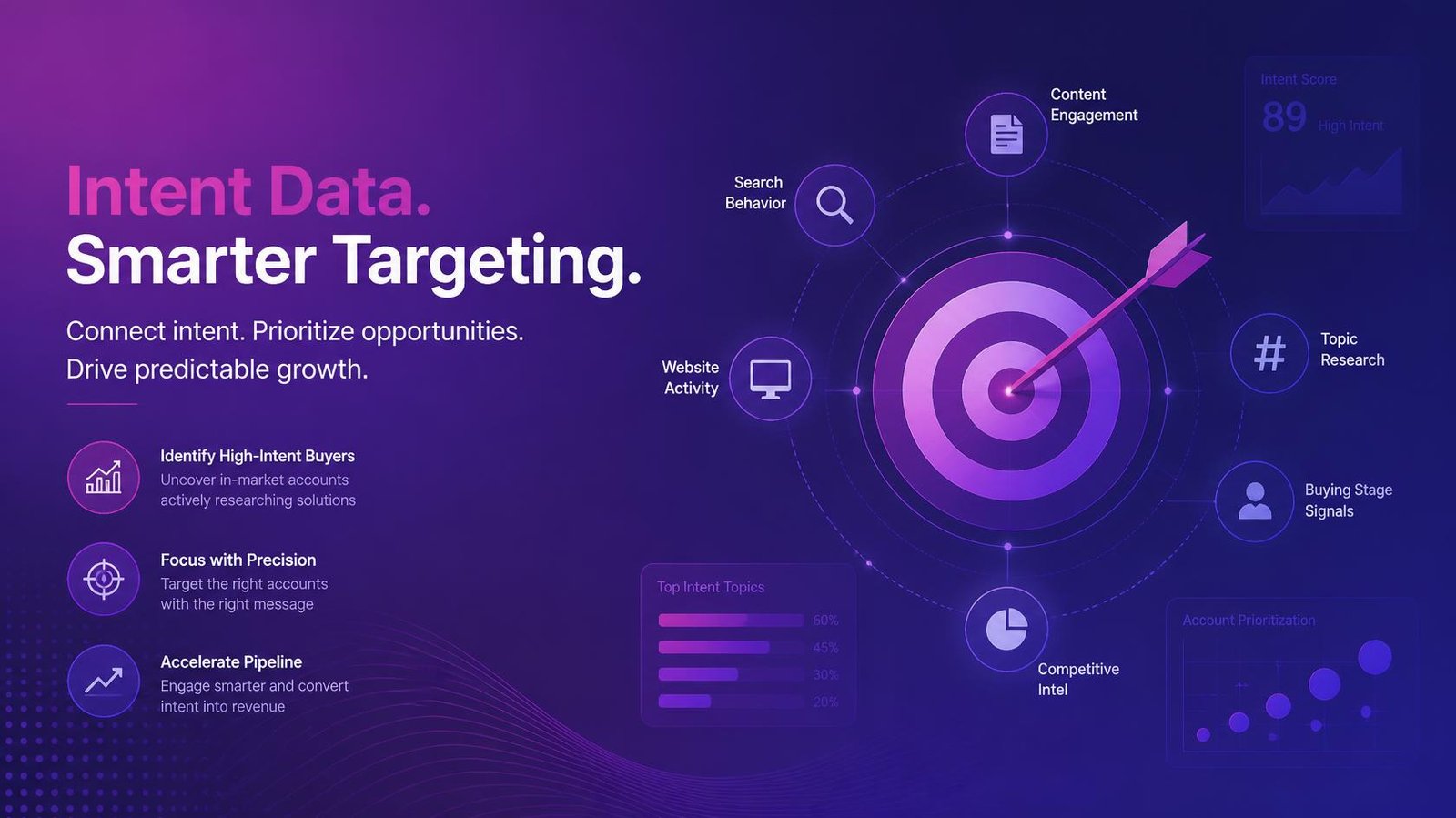
Instead of targeting prospects based only on industry, company size, job title, or other firmographic information, marketers can use buyer intent data to identify companies that are actively researching relevant products, services, and solutions.
With the right intent data targeting strategy, marketing and sales teams can identify buying signals, prioritize accounts, personalize campaigns, and engage prospects at the right stage of the B2B buying journey.
How B2B Intent Data Reveals Real Buyer Interest
For years, B2B marketers relied heavily on the Ideal Customer Profile (ICP).
If a company operated in the right industry, had the right number of employees, and matched the target market, it was considered a potential buyer.
But account fit doesn’t always mean buying intent.
A company can perfectly match your ICP but have no immediate need for your product. Meanwhile, another company outside your existing account list could already be researching the exact solution you provide.
This is where buyer intent data becomes valuable.
Intent signals can reveal what businesses are researching and which topics are gaining attention within an organization.
For example, a cybersecurity company may identify accounts researching:
- Identity management
- Zero-trust security
- Cloud security
- Threat detection
- Data protection
These activities can indicate that a company is experiencing a specific business challenge and may be entering the buying process.
Marketing teams can then create targeted content, personalized campaigns, and relevant sales outreach around those needs.
First-Party vs. Third-Party Intent Data
Understanding the difference between first-party intent data and third-party intent data is essential for building an effective B2B marketing strategy.
Both types of data can support lead generation, demand generation, account-based marketing, and sales intelligence—but they serve different purposes.
1. First-Party Intent Data
First-party intent data comes from interactions prospects have directly with your business.
Examples include:
- Website visits
- Product-page views
- Pricing-page visits
- Content downloads
- Webinar registrations
- Email engagement
- Demo requests
- Repeat visits
This data helps marketers understand how prospects are interacting with their brand.
For example, if a prospect repeatedly visits your pricing page, downloads a case study, and attends a product webinar, those combined signals may indicate stronger purchase intent.
2. Third-Party Intent Data
Third-party intent data helps identify potential buyers before they directly engage with your company.
It can reveal companies researching topics, technologies, products, or business challenges across external websites and content platforms.
For example, a cloud infrastructure company could use third-party intent data to identify organizations researching:
“Hybrid cloud strategy”
The marketing team can then add those accounts to targeted demand generation or ABM campaigns.
Why Combine First-Party and Third-Party Intent Data?
The strongest B2B intent data strategy often combines both.
Third-party data can help answer:
Who is researching the problem?
First-party data can help answer:
Who is engaging with our solution?
Together, these signals provide a more complete picture of the buyer journey.
For example:
- An account researches a business challenge.
- Third-party intent data identifies the account.
- The account visits your website.
- The prospect downloads a relevant resource.
- Multiple stakeholders engage with your content.
- The account visits a product or pricing page.
- Sales receives a stronger buying signal.
This creates a more informed approach to B2B lead generation and sales prospecting.
How Intent Data Improves B2B Marketing Campaigns
Intent data isn’t simply about identifying companies.
The real value comes from using those signals to determine what to show buyers and when to show it.
1. Identify the Problems Buyers Are Researching
Intent signals can reveal the business challenges prospects are trying to solve.
For example, a company researching:
“Employee retention strategies”
may be more interested in workforce engagement solutions than a generic HR technology advertisement.
Marketing teams can use this information to create content around the specific problem instead of promoting products too early.
2. Improve Content Timing
The needs of B2B buyers change throughout the purchasing journey.
Early-stage prospects may want:
- Industry reports
- Educational guides
- Research articles
- Webinars
- eBooks
Later-stage prospects may be more interested in:
- Product comparisons
- Case studies
- Pricing information
- Product demonstrations
- Customer success stories
Intent data targeting helps marketing teams match content to buyer behavior.
For example, a prospect researching cloud migration may initially receive an educational guide. After showing stronger engagement, the prospect could be presented with a case study or product demo.
3. Improve Content Marketing Investment
Intent data can also help marketers decide which topics deserve more investment.
If several target accounts are researching first-party data strategies, the marketing team may decide to create:
- An eBook
- A webinar
- A detailed guide
- A case study
- A comparison article
This allows content teams to build resources around real buyer interests instead of assumptions.
How to Identify High-Intent B2B Accounts
Not every intent signal indicates that a prospect is ready to buy.
Marketing teams need a framework for separating casual research from meaningful purchase intent.
1. Analyze Engagement Across Multiple Channels
Look at engagement across:
- Websites
- Content platforms
- Webinars
- Product pages
- Pricing pages
- Downloadable resources
One interaction may not mean much.
However, multiple interactions across different channels can create a stronger buying signal.
For example, an account that consumes third-party content and then repeatedly visits your pricing page may demonstrate stronger purchase intent.
2. Monitor Buying Group Activity
B2B purchases rarely involve only one person.
A typical buying group can include:
- IT managers
- Department heads
- Security professionals
- Procurement teams
- Finance leaders
- C-level executives
When multiple stakeholders from the same company begin researching similar topics, the account may be moving closer to a purchasing decision.
Buying group intelligence combined with intent data can therefore help sales teams identify high-value opportunities.
3. Combine Intent Data With Firmographic Data
Intent signals become more valuable when combined with account information.
Consider:
- Industry
- Company size
- Revenue
- Geography
- Technology stack
- Job roles
- Existing customer status
For example, a software company may prioritize accounts showing strong intent signals and matching its ideal customer profile.
This helps reduce wasted sales effort and improves account prioritization.
4. Score and Prioritize AccountsOrganizations can create an intent scoring model based on factors such as:
- Engagement frequency
- Topic relevance
- Account fit
- Website activity
- Content consumption
- Buying group activity
- Product-page engagement
An account that regularly researches relevant topics, repeatedly visits your website, consumes high-value content, and has multiple engaged stakeholders could receive a higher intent score.
Sales teams can then prioritize those accounts for outreach.
Intent Data and Account-Based Marketing
Account-Based Marketing (ABM) and intent data work particularly well together.
ABM focuses marketing and sales resources on specific high-value accounts.
Intent data adds another layer by helping teams determine which accounts are actively showing interest.
Instead of targeting every company within an industry, marketers can focus on accounts that:
Fit the ICP + Show buying intent + Match the target market
This creates a more focused approach to B2B demand generation and account-based marketing.
How Intent Data Supports B2B Lead Generation
Traditional lead generation often focuses on generating as many contacts as possible.
But more leads don’t necessarily mean more revenue.
Intent data helps shift the focus from lead volume to lead quality.
Marketing teams can identify accounts that are actively researching relevant topics and use those signals to create more targeted campaigns.
This can support:
- B2B lead generation
- Demand generation
- Account-based marketing
- Sales prospecting
- Lead scoring
- Pipeline generation
- Sales and marketing alignment
The result is a more data-driven approach to identifying qualified prospects.
The Future of B2B Marketing Is Intent-Driven
B2B buyers are conducting more research before speaking with sales teams.
They read articles, compare solutions, watch videos, download reports, attend webinars, and evaluate vendors long before submitting a contact form.
That means marketers need to understand what buyers are doing before they become leads.
Intent data provides valuable insight into those behaviors.
When combined with first-party data, third-party intent signals, firmographic information, buying-group intelligence, and lead scoring, it can help marketing and sales teams identify stronger opportunities and engage prospects at the right time.
The goal isn’t to collect more data. The goal is to turn buyer behavior into actionable intelligence.
And that’s where a strong B2B intent data strategy can give marketing and sales teams a competitive advantage.
Ready to turn buyer intent into qualified opportunities?
Discover how SalesGarners can help your team identify, engage, and convert high-intent B2B prospects.