
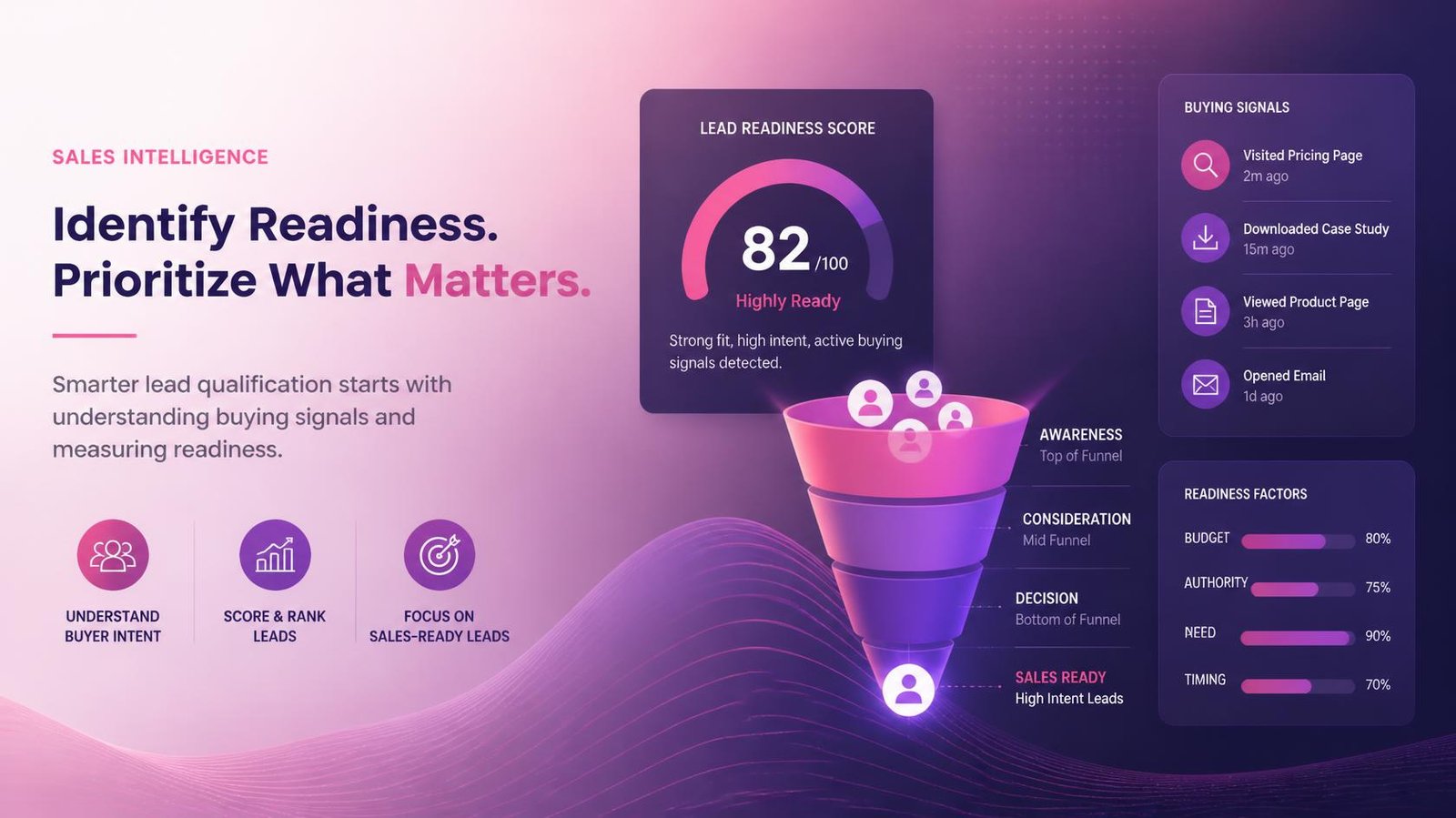
Ask ten sales reps how they decide which leads to call first, and you’ll probably get ten different answers. Some go by gut feeling. Some just work the list top to bottom. Some chase whoever filled out a form most recently, regardless of whether that person has looked at anything since.
None of that is really their fault. Most teams have never been given a reliable way to answer a very simple question: is this person actually interested, or just passing through?
Let’s talk about what it takes to actually answer that and why so many teams get it wrong.
The Problem With “One Size Fits All” Lead Lists
Here’s a familiar scene. Marketing hands sales a list of 200 “leads” for the month. Sales starts working through it. A handful convert. Most don’t. Nobody’s quite sure why was the list bad? Was the timing off? Did sales just not get to the right people in time?
The honest answer is usually: the list treated every lead as equal, when they clearly weren’t.
Someone who opened one email newsletter and someone who watched your entire product demo video twice, downloaded your pricing sheet, and came back to your site three days in a row are not the same lead. But if your only signal is “did they engage, yes or no,” they’ll look identical on paper.
That’s the core problem with basic engagement tracking it’s binary when reality is a spectrum.
What Real Buying Intent Actually Looks Like
Buying intent rarely announces itself with a phone call. It shows up in smaller, quieter signals, stacked over time:
- Someone reads your pricing page slowly, not once, but two or three times over a week
- A prospect who watched the first 30 seconds of a demo video comes back and finishes the whole thing
- A lead who downloaded a case study opens it again right before a scheduled call
- Someone who’s been quiet for weeks suddenly visits your landing page three times in two days
Individually, none of these moments scream “ready to buy.” Together, they tell a pretty clear story if someone’s actually watching for it.
Turning Signals Into a Score You Can Trust
This is where lead scoring earns its keep, but only if it’s built on real behavior instead of assumptions. Here’s roughly how it should work, and how X-Engage approaches it:
1. Capture everything, down to the second. Every interaction with a video, PDF, or landing page gets tracked — not just whether it happened, but when, for how long, and how many times.
2. Look for patterns, not one-off actions. A single click means very little on its own. A pattern of returning visits, longer session times, and repeat downloads means quite a lot.
3. Consolidate the data in one place. If your video engagement lives in one tool and your landing page data lives in another, no one can see the full pattern. X-Engage pulls it all into a single, centralized view of lead activity.
4. Let the score do the sorting. Instead of sales guessing who to call first, the platform automatically scores leads based on real engagement so your team’s time goes to the people most likely to convert.
5. Act while the moment is still warm. Timely data matters. A lead who was hot last week and has gone quiet since needs a different approach than one who just spent ten minutes on your pricing page an hour ago.
Why This Matters More Than It Seems
When lead scoring actually reflects behavior, something quietly shifts inside a company. Marketing stops sending sales a wall of names and starts sending a short list of people worth calling. Sales stops burning hours on cold trails and starts spending that time on conversations that go somewhere. And leadership finally gets a real answer to “is this working?” instead of a shrug.
It’s a small change in process with a fairly large effect on morale, momentum, and eventually revenue.
The Takeaway
You don’t need more leads. You need to know which ones are actually worth your team’s time right now. That’s not a data problem you solve with more spreadsheets it’s a visibility problem you solve by finally connecting the dots between what people do and what it means.
Want to see what your leads have already been telling you? Explore how X-Engage turns engagement into evidence.