
A B2B marketing team launches a content syndication campaign to promote an eBook to IT professionals.
The campaign generates downloads, but something is missing. Many of the people engaging with the content are interested in the topic but aren't actively looking for a solution.
Meanwhile, other companies may already be researching products and solutions in the same category but aren't being reached by the campaign.
This is where intent data for content syndication can change the strategy.
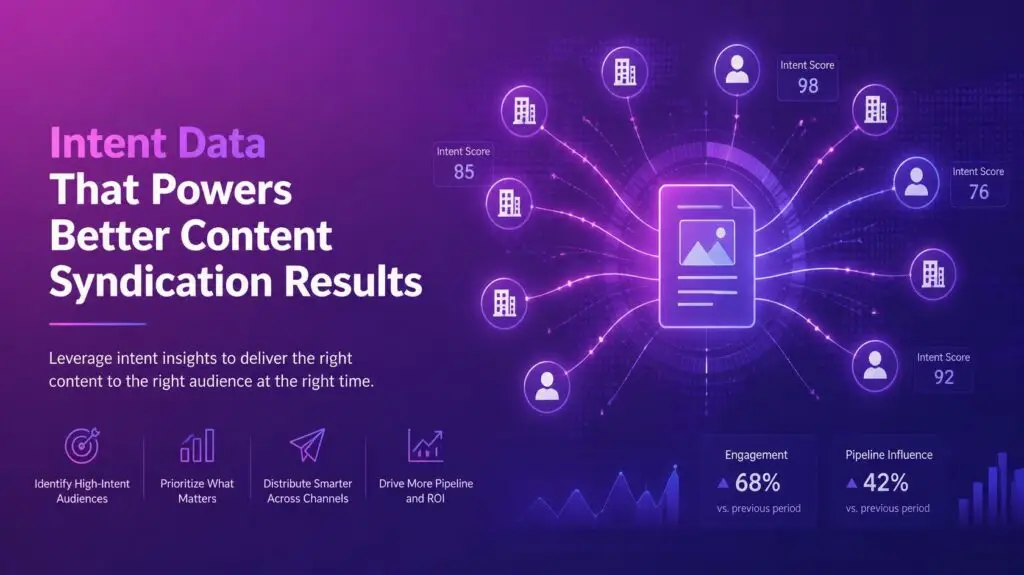
Instead of distributing content to a broad audience and hoping the right buyers engage, marketers can use buyer intent data to identify accounts showing interest in relevant topics.
The result is a more targeted approach to B2B content syndication, lead generation, and demand generation.
Why Combine Intent Data With Content Syndication?
Traditional content syndication focuses heavily on reaching the right audience and generating content downloads.
But a download alone doesn't tell marketers whether someone is ready to buy.
Intent data adds another layer of intelligence.
It can help marketing teams understand:
- Which accounts are researching relevant topics
- What problems buyers are trying to solve
- Where prospects may be in the buying journey
- Which accounts are showing increased interest
- When sales outreach may be more relevant
Combining content syndication and intent data allows marketers to move beyond lead volume and focus more on qualified, high-intent accounts.
It can also improve content relevance, audience targeting, lead scoring and marketing efficiency.
Match Content to Buyer Intent Signals
Not every prospect needs the same content.
A buyer researching a problem for the first time has different needs from someone comparing vendors.
Using intent data, marketers can align content with different stages of the B2B buyer journey.
1. Awareness Stage: Use Educational Content
At the awareness stage, buyers are usually researching business challenges, trends and potential solutions.
Marketers can use intent signals to identify accounts researching relevant topics and promote:
- Industry reports
- eBooks
- Research studies
- Thought leadership articles
- Educational guides
For example, an account showing interest in cloud security risks could receive a report such as:
“The State of Cloud Security in 2026.”
The goal is to educate the buyer rather than immediately push a sales message.
2. Consideration Stage: Deliver Solution-Focused Content
As buyers move into the consideration stage, their research becomes more specific.
They may start comparing technologies, vendors, features and implementation approaches.
This is the right time to promote:
- Buyer guides
- Whitepapers
- Solution briefs
- Analyst reports
- Product comparison content
For example, an account researching customer data platform comparisons could receive a buyer's guide explaining key CDP capabilities and evaluation criteria.
This makes content more relevant to the buyer's current needs.
3. Decision Stage: Provide Proof-Based Content
At the decision stage, buyers are often looking for evidence that a solution can deliver results.
Intent signals around pricing, vendors, product features and implementation can indicate stronger purchase interest.
Marketing teams can promote:
- Case studies
- ROI reports
- Customer success stories
- Product demonstrations
- Pricing information
- Comparison guides
For example, a prospect researching marketing automation ROI could receive a case study showing how another company improved conversions after implementing the technology.
4. Re-Engagement Stage: Identify Renewed Interest
Not every prospect converts immediately.
Some accounts may become inactive and return to researching the same category months later.
Intent data can help identify this renewed interest.
For example, an account that stopped engaging six months ago may suddenly begin researching identity management platforms again.
That could be an opportunity to re-engage the account with:
- New research
- Updated industry reports
- Webinars
- Product content
- New customer stories
The timing of the message can be just as important as the message itself.
5. Post-Engagement Nurturing: Continue the Conversation
Content syndication shouldn't end when someone downloads an asset.
The next step should depend on what the prospect does afterward.
For example:
A company downloads an eBook about data governance.
Later, the same account starts researching compliance solutions.
Instead of sending another generic eBook, the marketing team could provide an implementation checklist, webinar or solution guide related to compliance.
This creates a more personalized content journey.
The Technology Behind Intent-Driven Content Syndication
Intent-driven content syndication typically relies on several technologies working together.
1. Intent Data Platforms
Intent data platforms help identify companies researching specific topics, products and business challenges.
For example, a cybersecurity company may identify increased interest in zero-trust security among its target accounts.
The marketing team can then create a targeted content syndication campaign around that topic.
2. Marketing Automation Platforms
Marketing automation platforms help turn intent signals into personalized campaigns.
They can support:
- Lead scoring
- Email nurturing
- Audience segmentation
- Campaign automation
- Content recommendations
- Follow-up workflows
For example, a prospect researching customer experience software could receive an industry report followed by a webinar invitation.
3. Data Enrichment PlatformsIntent signals become more useful when combined with additional account information.
Data enrichment can provide information such as:
- Company size
- Industry
- Location
- Technology usage
- Job roles
- Revenue
- Contact information
This allows marketers to build more precise audiences and create industry-specific content syndication campaigns.
Measure Content Syndication by Pipeline, Not Just Downloads
Content downloads are useful, but they shouldn't be the only measure of success.
For B2B marketers, the bigger question is:
Did the campaign create meaningful sales opportunities?
Intent data can help connect content engagement with pipeline performance.
1. Measure Pipeline Contribution
Identify which intent signals and audience segments contribute to opportunities.
For example, accounts researching data governance may generate more opportunities than accounts showing only broad interest in digital transformation.
This insight can help marketing teams invest more resources in high-performing audiences.
2. Analyze Sales Velocity
Compare how quickly high-intent accounts move through the sales funnel.
For example:
- High-intent accounts → 20 days from MQL to opportunity
- Standard leads → 45 days from MQL to opportunity
If high-intent accounts consistently move faster, that information can help marketing and sales prioritize similar prospects.
3. Measure Cost Per Opportunity
Cost per lead doesn't always tell the full story.
A campaign may generate inexpensive leads but very few sales opportunities.
Another campaign might generate fewer leads but produce significantly more qualified opportunities.
That's why B2B marketers should evaluate:
- Cost per lead
- Cost per MQL
- Cost per opportunity
- Pipeline generated
- Revenue influenced
- Conversion rate
This provides a clearer picture of content syndication ROI.
4. Build a Sales and Marketing Feedback Loop
Sales teams can provide valuable feedback about the quality of intent signals.
For example, sales may discover that accounts researching AI governance convert faster than accounts showing broader technology interest.
Marketing can use that feedback to refine its audience targeting and content strategy.
This creates a continuous cycle:
Intent Data → Targeting → Content → Engagement → Sales Feedback → Optimization
The Future of Intent-Based Content Syndication
B2B buyers are becoming more independent.
Before contacting sales, they may research problems, compare vendors, consume content, watch webinars and evaluate solutions.
This makes understanding buyer intent signals increasingly important.
Instead of waiting for prospects to complete a form, marketing teams can use intent data to identify early signs of interest and align their campaigns with the buyer journey.
When intent data and content syndication work together, marketers can:
- Reach more relevant accounts
- Improve content engagement
- Identify high-intent buyers
- Generate better-qualified leads
- Personalize content distribution
- Improve sales and marketing alignment
- Build stronger pipelines
The goal isn't simply to generate more content downloads.
The goal is to reach the right buyers with the right content at the right time.
That's the real value of intent-driven B2B content syndication.
Ready to turn buyer intent into better leads?
SalesGarners helps B2B companies identify, engage and connect with relevant audiences through data-driven marketing and lead generation solutions.