
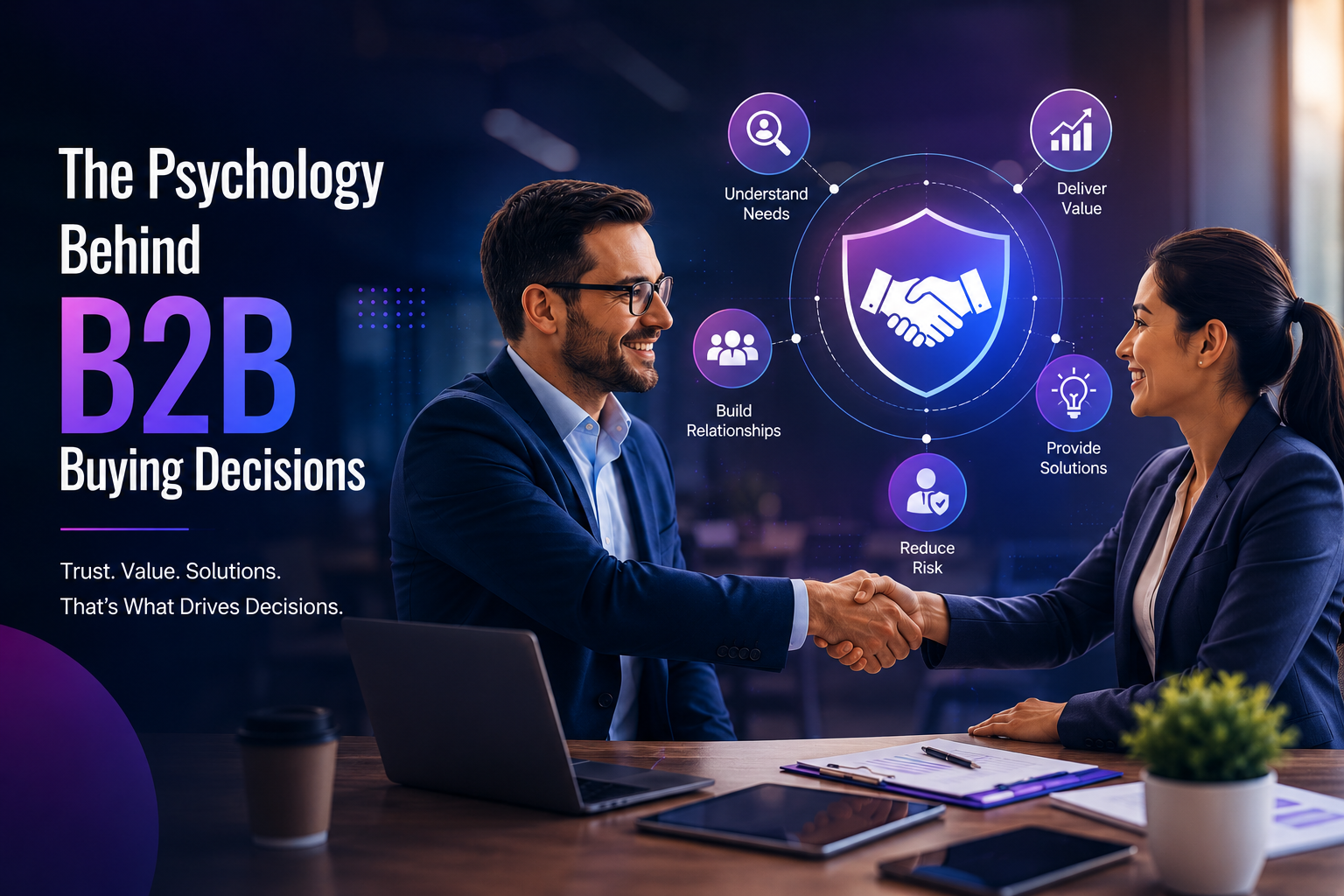
The Psychology Behind B2B Buying Decisions: Why Trust, Risk & Relationships Win Deals
People don't buy products. They buy confidence, trust, and solutions.
Every B2B deal looks logical on the surface proposals, pricing comparisons, feature lists, approval chains. But behind every decision is a person trying to reduce risk and make a choice they can defend later.
B2B buying isn't just about price, features, or ROI math. Buyers are also weighing trust, credibility, and whether a company actually understands their situation.
Most businesses assume B2B buyers are purely rational. They're not - psychology plays a major role. Buyers want confidence that their decision will produce results and protect their professional reputation.
This post breaks down the psychology behind B2B buying decisions -trust, risk, personalization, relationships, and value and how each one shapes whether a deal closes.
Key Factors That Influence B2B Buying Decisions
Trust → Reduced Risk → Confidence → Purchase Decision → Long-Term Partnership
- Why trust influences B2B buying decisions
- How buyers evaluate risk before purchasing
- Why personalization improves engagement
- Why relationships matter more than one-time transactions
- Why value beats price
- How sales teams can apply all of this
Trust Comes Before the Sale
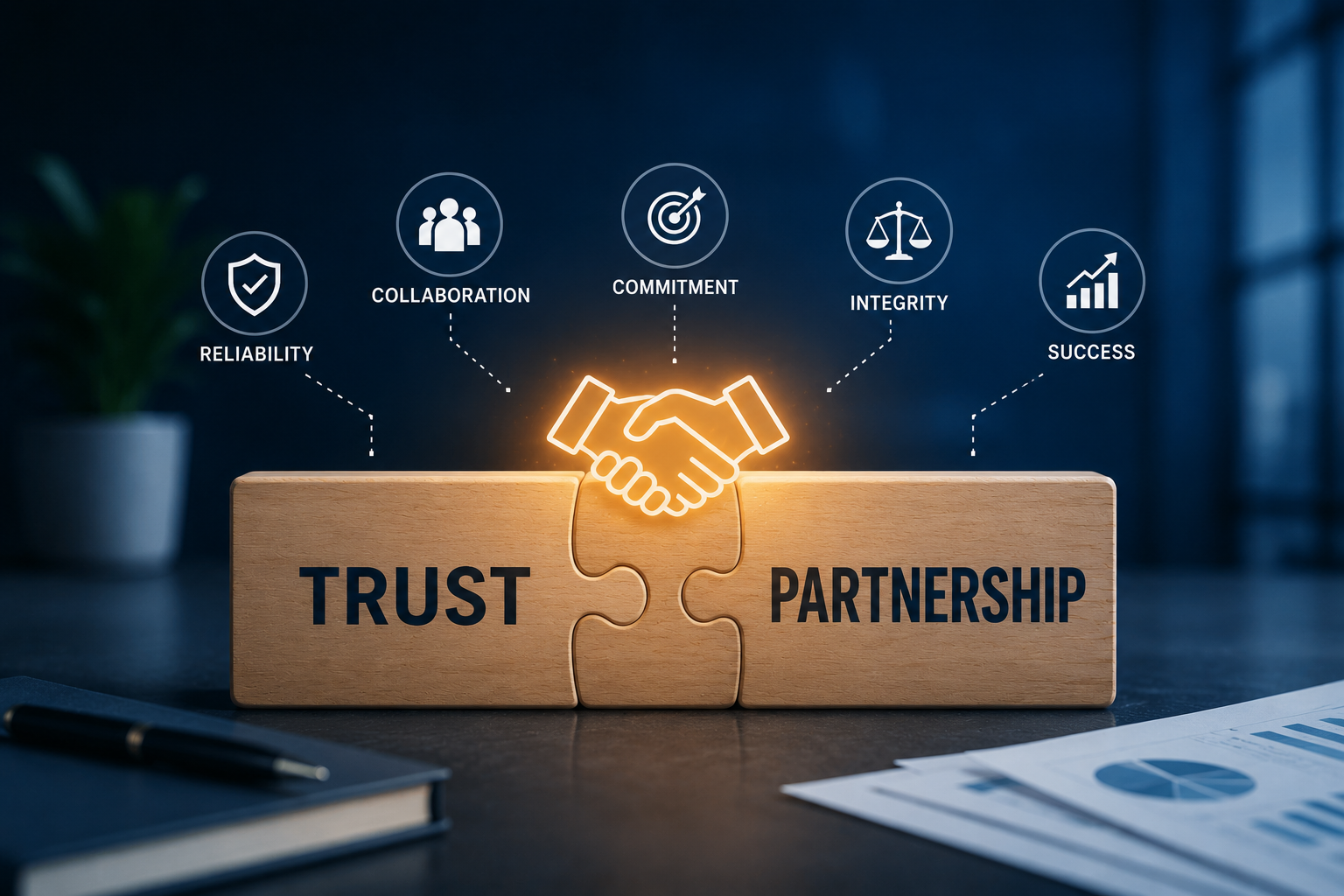
Why Trust Shapes Buyer Confidence ?
Before comparing prices or booking a demo, every buyer silently asks: can I trust the people behind this?
Trust isn't a nice to have- it's the entry ticket. Decision-makers aren't only spending company money; they're spending their own credibility. If a vendor under delivers, it's their name on the line internally.
Salesforce research confirms this: buyers consistently expect vendors to understand their goals before pitching a solution — not after.
Where trust gets built (or lost):
Trust Builders:
- Case studies with real numbers
- Consistent, professional online presence
- Transparent pricing and process
- Industry-specific language and insight
Trust Killers:
- Generic "we help businesses grow" claims
- Inactive website or social profiles
- Vague answers to direct questions
- Copy-paste pitches that ignore their sector
Two SaaS companies, same product, different outcome:
Company A opens with a demo and a price sheet.
Company B opens by asking about the buyer's operational bottlenecks, then shares a relevant customer story.
Same product, same price — Company B wins more often, because trust was built before the pitch started.
Businesses Buy Solutions, Not Services
Shifting From Product Selling to Problem Solving
B2B buyers aren't shopping for "another vendor." They're shopping for a fix to a specific problem. A company doesn't search for "lead generation services" because it wants a new supplier — it searches because it wants more qualified pipeline and better revenue outcomes.
Gartner research shows B2B buyers spend limited time directly interacting with suppliers during their buying journey — so vendors need to communicate value fast, or get skipped.
Same service, two different pitches:
| Weak Positioning | Strong Positioning |
|---|---|
| "Network monitoring services" | "Preventing costly downtime with 24/7 network protection" |
| "Lead generation for B2B companies" | "Helping you reach the right decision-makers faster" |
| "Sales training programs" | "Turning your reps into consultative sellers who close bigger deals" |
Same underlying service — but the second column speaks to the outcome, not the task. That's the difference between getting ignored and getting a reply.
Risk Reduction Drives Buying Decisions
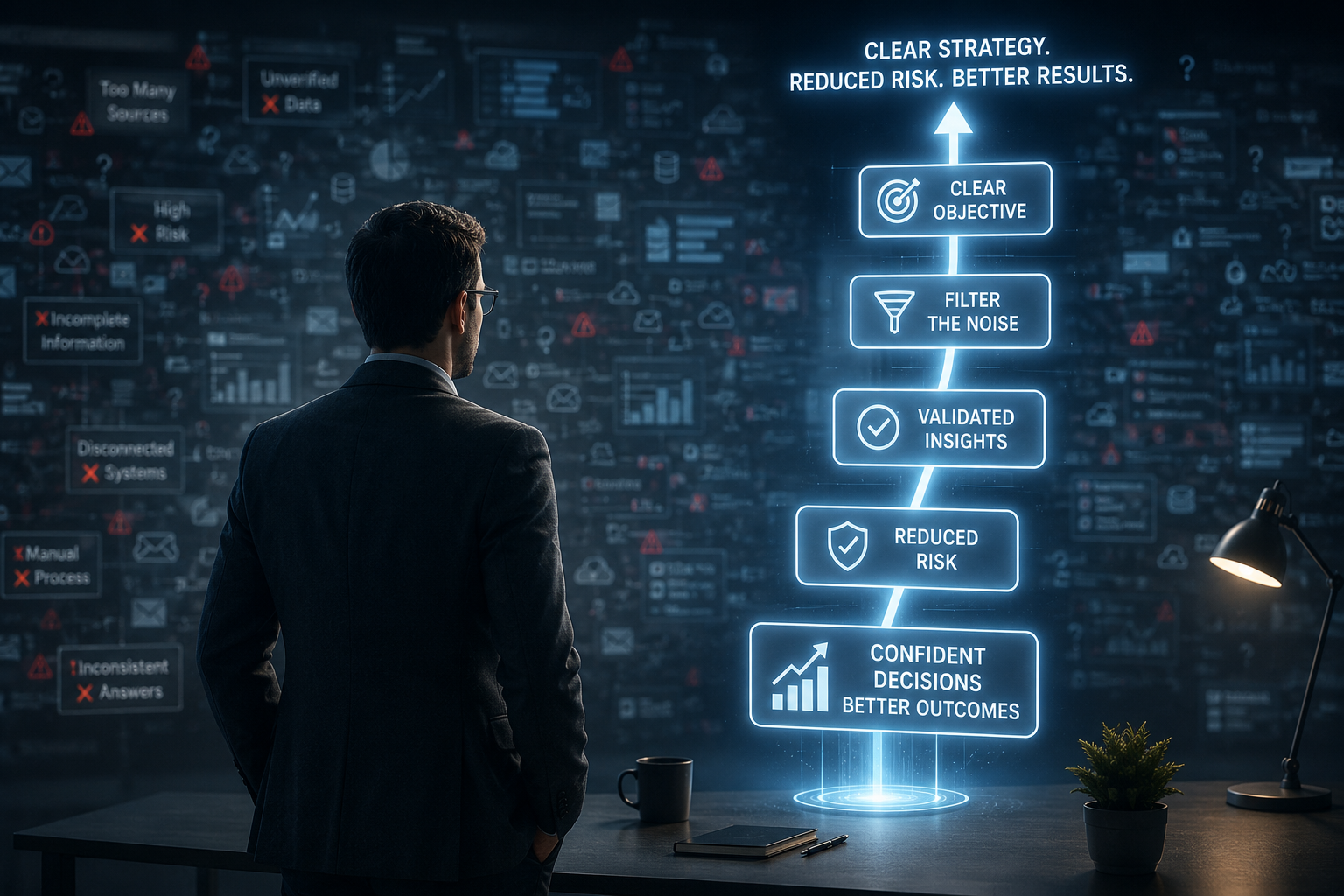
What Buyers Are Really Afraid Of :
Every purchase carries a hidden question buyers rarely say out loud: what if this goes wrong?
Broken down by role, that fear sounds like:
- The person signing the contract — "Will I look bad if this fails?"
- The finance stakeholder — "Is this actually worth the budget impact?"
- The operations team — "How much disruption will this cause during rollout?"
- The end users — "Will we need extensive retraining just to use this?"
Because B2B deals usually involve multiple people, each with a different worry, a single "great product" pitch rarely reduces all the risk at once.
Case in point: a manufacturer evaluating a new ERP system isn't just weighing software cost — they're weighing training time, data migration, and rollout disruption. The vendor who addresses all four of these upfront, with a clear onboarding plan and proof from similar clients, removes hesitation faster than the one who just talks features.
In the end, closing a B2B deal isn't about having the best pitch — it's about being the vendor who already answered the questions no one asked out loud.
Personalization Creates Stronger Connections
What Personalization Actually Looks Like !
Buyers are flooded with generic outreach daily. A message that ignores their industry or specific challenges gets deleted, not opened.
McKinsey research shows customers increasingly expect personalized interactions — and engage more with companies that deliver them.
Two reps, same prospect — spot the difference:
Rep 1: "Hello, we provide lead generation services. Let us know if you're interested."Rep 2: "We noticed your company is expanding its B2B sales efforts. Many organizations at this stage struggle reaching the right decision-makers — our approach helps improve pipeline quality through targeted lead gen."
Rep 2 wins, not because the pitch is longer, but because it proves the sender actually looked at the buyer's situation before hitting send. Personalization isn't a first-name mail merge — it's demonstrated understanding.
Relationships Outperform Transactions
Why Long-Term Partnerships Create More Value
Unlike most consumer purchases, B2B relationships don't end when the contract is signed. In many ways, that's when the real evaluation begins. Buyers continue asking themselves:
- Is this company reliable over the long term?
- Will they support us after the sale?
- Will they understand our evolving business needs?
Imagine a business receives a lower-priced proposal from a competing vendor but still chooses to stay with its current provider. The reason isn't price — it's confidence. Their existing partner understands their operations, communicates proactively, and resolves potential issues before they become problems. Over time, that trust becomes more valuable than a short-term discount.
Organizations that view every sale as a one-time transaction may generate immediate revenue. Those that invest in lasting partnerships earn customer loyalty, repeat business, referrals, and sustainable long-term growth.
Value Wins Over Price
How to Make Value Impossible to Ignore
Price always matters — but it's rarely the deciding factor. B2B buyers aren't simply looking for the lowest quote; they're evaluating the return they'll receive from their investment.
A lower-priced option quickly loses its appeal if it can't provide:
- Better business outcomes
- Reliable support
- Reduced risk
- Long-term value
Imagine a manufacturing company evaluating two software platforms. One vendor offers a significantly lower price, while the other demonstrates how its solution will automate manual processes, reduce operational errors, improve reporting, and save hundreds of employee hours each year.
Although the second solution requires a higher upfront investment, the decision becomes straightforward. The buyer isn't paying more for software — they're investing in greater efficiency, lower operational costs, and measurable business results.
The same principle applies across every B2B industry. When value is difficult to see, price becomes the primary point of comparison. When value is clearly demonstrated through outcomes, expertise, and long-term impact, buyers focus on what they'll gain rather than what they'll spend.
Traditional Selling vs. Psychology-Based Selling
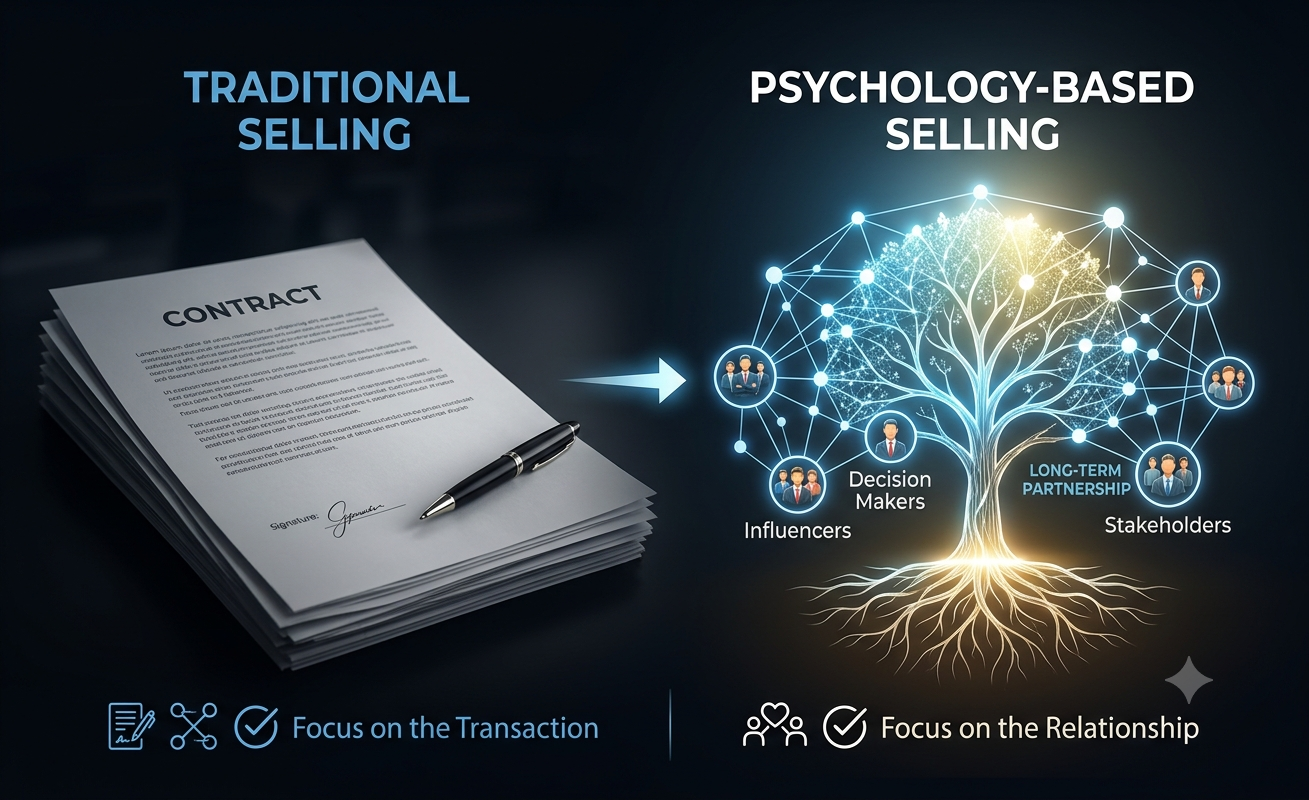
| Traditional Selling | Psychology-Based Selling |
|---|---|
| Focuses on products | Focuses on buyer problems |
| Uses generic messaging | Uses personalized communication |
| Competes mainly on price | Competes through value |
| Focuses on closing deals | Focuses on building relationships |
| Short-term approach | Long-term partnership approach |
Common B2B Sales Mistakes That Kill Buying Confidence
- Leading with features instead of outcomes — buyers care about business impact, not specs.
- Ignoring buyer concerns — unaddressed risk becomes an objection later.
- Generic outreach — mass messaging without personalization gets ignored.
- Disappearing after the deal closes — the relationship should continue past the signature.
- Competing only on price — a race to the bottom that erodes perceived value.
How Sales Teams Can Apply Buyer Psychology
- Ask before you pitch — understand goals and challenges before presenting anything.
- Address risk early — surface concerns before they become objections.
- Map the buying committee — different stakeholders, different fears, different messaging.
- Communicate value in outcomes — revenue growth, efficiency, time saved — not just features. Strong B2B data services help identify the right decision-makers to target this messaging accurately.
- Stay present after closing — ongoing communication turns customers into long-term partners.
Key Insights From B2B Buying Psychology
- Trust builds confidence in buying decisions.
- Buyers purchase solutions, not services.
- Reducing risk speeds up decision-making.
- Personalized communication drives stronger engagement.
- Long-term relationships build loyalty and growth.
- Demonstrated value outperforms price competition.
Conclusion: Understanding the Human Side of B2B Buying
B2B buying decisions are shaped by far more than pricing and feature lists. Behind every decision is a person looking for confidence, reliability, and a partner who understands their challenges.
Companies that succeed in B2B sales aren't always the cheapest or most feature-rich — they're the ones who understand buyer psychology and build value throughout the entire customer journey.
At SalesGarners Marketing Pvt. Ltd., we help businesses connect with the right decision-makers through strategic B2B marketing — demand generation, content syndication, lead generation, and data-driven strategy.
Explore Our B2B Growth Solutions →
Frequently Asked Questions
What are B2B buying decisions?
Choices businesses make when purchasing from other businesses — usually involving multiple stakeholders, longer evaluation periods, and careful weighing of value against risk.
Why is trust important in B2B sales?
It helps buyers feel confident in their choice. Since B2B purchases often involve significant investment, buyers prefer vendors who demonstrate credibility and reliability.
How does psychology influence B2B buying decisions?
Buyers weigh logical factors (ROI, pricing) alongside emotional ones (confidence, trust, risk reduction) — both matter.
Why is personalization important in B2B marketing?
It shows buyers their specific situation is understood, which drives stronger engagement than generic outreach.
How can companies reduce buyer risk?
Through customer success stories, transparent communication, measurable proof, and strong post-purchase support.
Why are relationships important in B2B sales?
Because B2B partnerships continue beyond the first purchase — strong relationships create loyalty, repeat business, and long-term growth.